June 14, 2012

A Week With A Small Farm Family

Photo dump! 


In case you're as scattered as I am and just want to look at something and not think for a second, I give you:

The week in pictures from a life cultivated and Prairie Heritage Farm...


Morning sun is about all we get in our otherwise, dark, dark, little house in town. Oh, what we wouldn't give to finally live out in the country. To live where we work the land.

We're working on it. But for now, we have all the stresses and risks of running a small farm with few of the perks, like you know, waking up with the sun streaming through the windows, or picking fresh veggies from your backyard for dinner, or playing, whenever you want, in the dirt with your daughter.

Someday, little one, some day.

For now though, we spend a lot of time outside to pretend like we live on a farm. As much as we can, we get outside to the farm itself, and every other waking moment we get outside in the backyard.

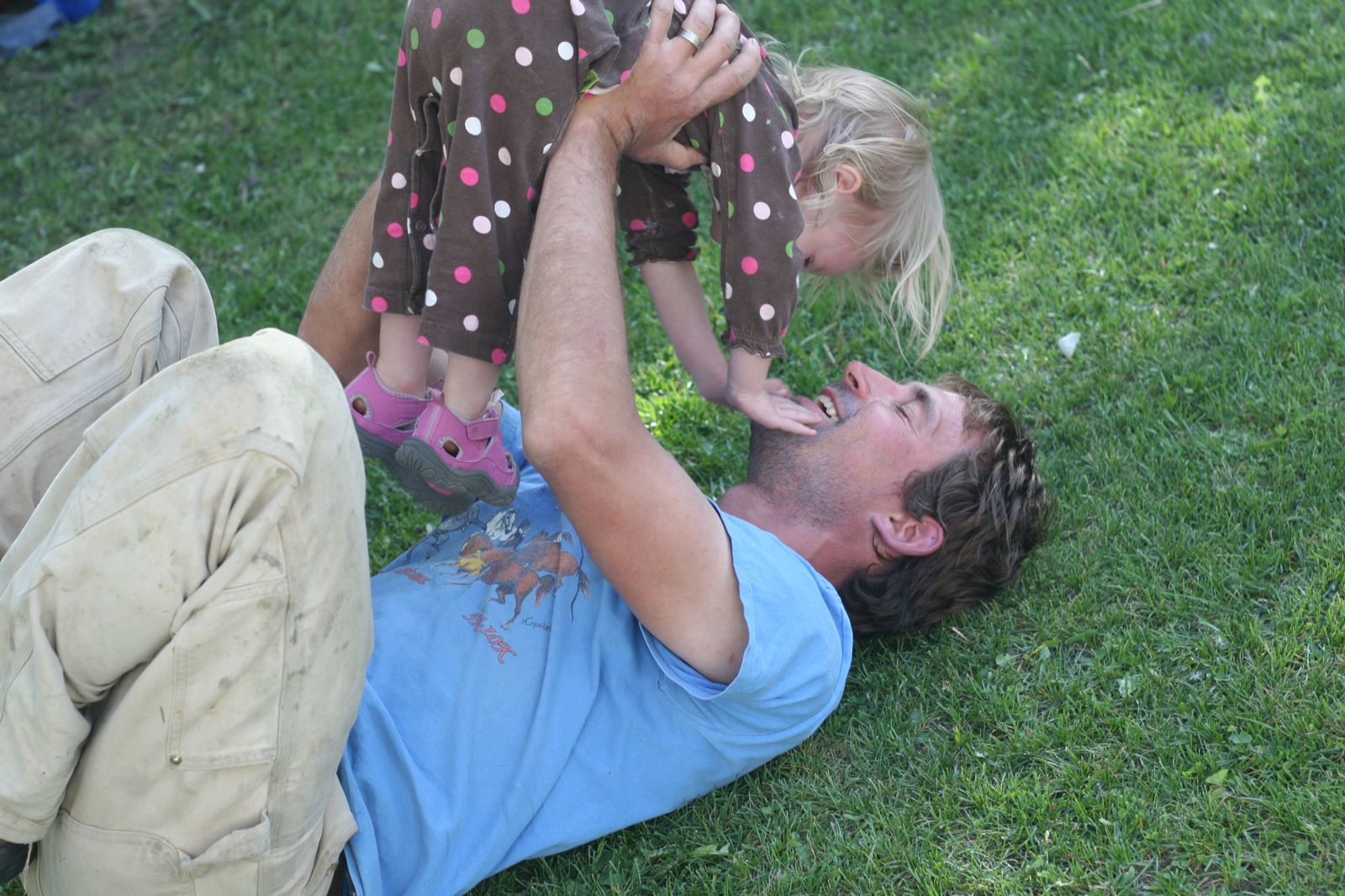
(Happy Father's Day, by the way, to this guy. What an awesome Papa he is.)


Or, we grab some valuable time at the park.
This is Willa's new "smile." Ask her to smile for the camera and she goes one step too far turning that frown upside down with her hands. 

 Last Wednesday, we hit the road to see Auntie Hannah graduate. Only the cool kids were allowed on the trip.
We met some nice chickens at the Museum of the Rockies, where we wandered through Jacob's favorite museum exhibit of all time: The Living History Farm. He said, at least twice, and wistfully, "I think I was born at the wrong time." 

If this guy had a time travel device, he would so be living on a turn-of-the-century (and I mean last century) farm, wearing suspenders and doing everything by hand. (See the photo in this post as evidence.) Jacob, of course, chatted it up with the farm folks and ended up leaving with some seedlings of an old variety of red orach, a red spinachy-kind of leafy veggie.

 And, the whole family got to practice their Willa smiles.

And finally, Willa and I got some farm time in this week. (We're home a lot these days while Papa toils in the dirt, given my whole online editing job, which you know, requires an Internet connection, which is absent at the farm.) You can almost hear things growing out there. (The weeds too though.)


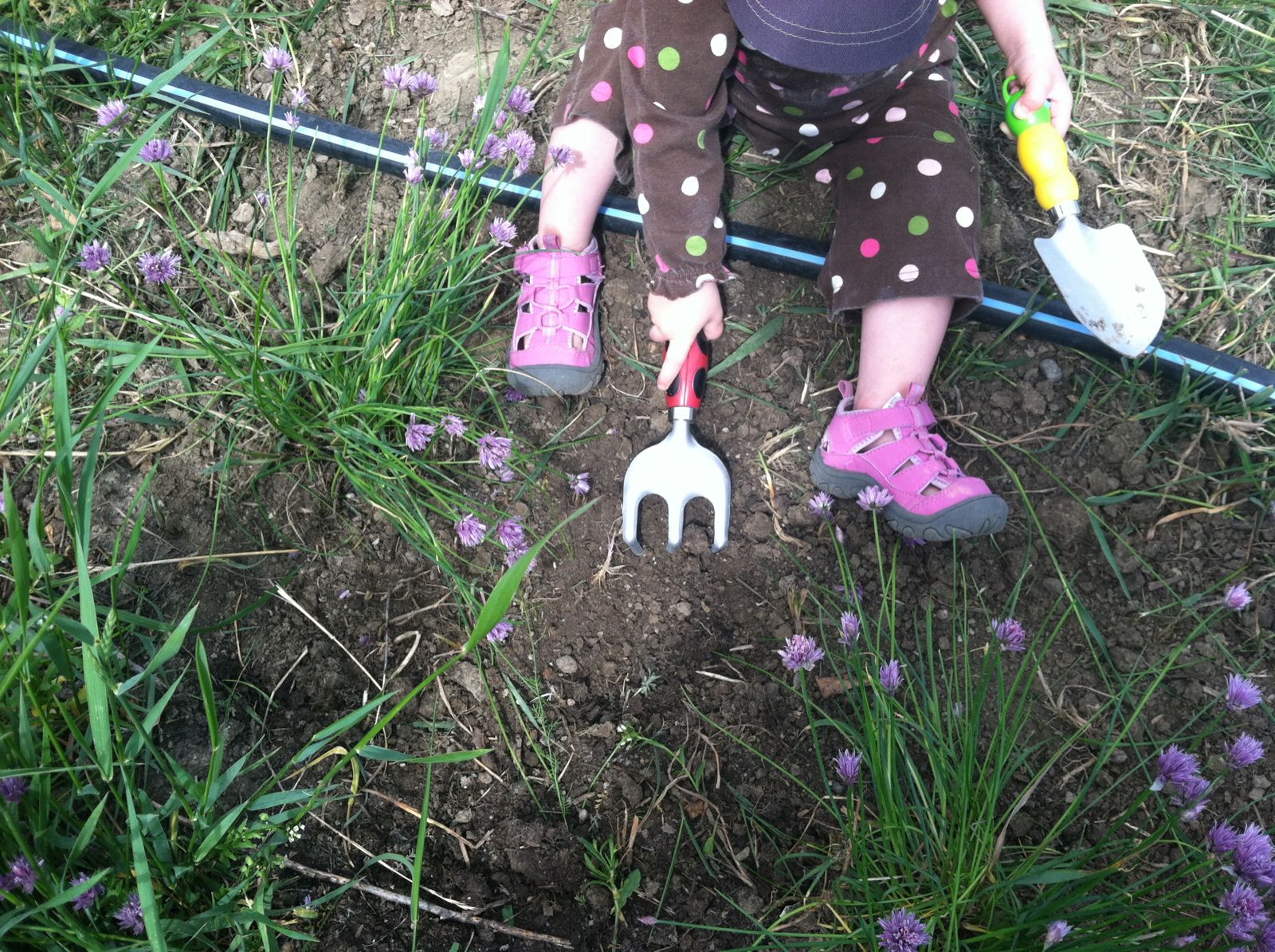
Willa and I took care of some little bunches of chives that were buried under a mountain of quack grass while we were out there. And, oh, it felt good to dig and pull and smell and talk about what dirt and sun do for plants and which plants are yummy and which ones are yuck. 

It's a dandy thing, hanging out with a kid on a farm.

And, don't tell my husband, but I really miss the whole manual labor side of the farming thing, a lot, even the weeding part.


This is what we'll be doing again this weekend: driving first to Great Falls on Friday to deliver fresh veggies to our awesome customers there and then on to Helena for the Farmer's Market on Saturday morning, where we meet up with more awesome farm share customers and watch Jacob build up his quads using a bike-powered flour mill to get the fine people of Helena freshly-ground, flour from organic, heritage wheat. 

Nothing like it.


May 24, 2012

A Time Capsule, Or How One Person's Trailer Trash Might Be Another's Childhood

Our two farm apprentices arrived. And let me tell you, they're magic. Pure magic. Not only are they awesome folks to be around, they're super duper hard workers and for once, for once, we actually feel like we have the labor figured out on the farm. That's a big step for a small business.

The apprentices mean I don't need to be out there toiling in the dirt and sun as much and now that I have an more-than-part-time off-farm job and a toddler to chase, that works best for our lives. But, I can't say I don't miss it. I do. A whole lot. But, I'll still get out a few afternoons a week and get sufficiently dirty, I hope.

When we do get out to the farm, we try to do so by bike. Pretty awesome road biking around here for a Mama and Toddler.


Also, when on the farm, we always strive to look farmy.


And, while at home, we try to be as useful as possible, researching all things pertinent to small farmers, like, say, reading the most recent issue of ACRES USA magazine. (Someone has to know how do decode the nutrient density of our crops.)


In other news, in order to house aforementioned magic apprentices, we are borrowing this awesome camper trailer from my Dad.


I spent some good weekends in this as a kid and I don't think it's been used since the Lowerys last took it on the road, circa 1985.

So, this thing is like a time capsule on wheels.

It's so funny, how something you didn't even know you remembered can bring back such vivid memories.

Things like a 30-year-old baby doll, a rainbow hair band, a cassette tape, the print of a camper cushion, the lid of a margarine container, an empty box of clay, a key chain, a few handmade potholders, the top from a popsicle maker.


Aww... early 80s, you were totally rad.

May 12, 2012

Convincing Ourselves We're Mom Enough, Or What is Really Undermining Women


As a relatively new mother, I'm still figuring out my role – in the house, in the family, in the workplace, in the business world, in the mothering world and in my own sense of self.

It's a nuanced, complex and challenging place to be. But, it's my place to be. And in this place, I'd like to think I am fully thinking, and feeling, my way through it all -- my own way through it all.

But the last few weeks, a debate has been building online and off that insinuates otherwise – that seems to claim that in fact, my decisions as a mother are made from a place of influence, or fear, or insecurity.

So, I'll say this as eloquently as I can right now: Hooey. Pure, freaking, hooey.

Let me just go ahead and save you the trouble of answering the rhetorical questions raised by this firestorm of pre-Mother's Day media, by these so-called “mom wars.” (Really? Inflame much? “Wars?”)

First to the most recent question – the one posited on the cover of Time Magazine: “Are You Mom Enough?”

The answer is: Yes. No matter if you're an “attached parent” or not, the answer is yes. You are mom enough. 

Ok, that's done.

Secondly, to the question raised by the debate over Elisabeth Badinter's book – the question of “Has Modern Motherhood Undermined Women?”

The answer is: No. Absolutely not.

But you know what is undermining women?  This crap.

All of it.

This crap. And this crap. And this crap.

And what's worse – women participating in this crap -- women spitting at each other from across imaginary boundaries between the right way and the wrong way to be a mother, or a woman.

It's an old tactic, you know, making women think that the real enemy is each other.

And, we're so quick to take the bait, aren't we? (You need to look no further than that Time cover to see the evidence of "bait." See what they're doing there with that cover? To use “war” terminology, it's a blatant attempt to incite violence. And, I've been so disappointed to see, all over, that it's working.)

It's either:
Oh, so you make all your own baby food? You're probably totally be judging me for the Goldfish cracker I just fed my kid, but you know what? Screw off, you're the one doing it wrong.

Or:
So, your kid sleeps through the night? In his own crib? And, I bet you think I'm totally enabling my kid by sleeping with her, don't you? But, you know what? Screw off, you're the one doing it wrong.

You've all heard some versions of these conversations, right? I have. Both of them. Both in my own head.

But here's a little secret: that piously “attached” mom you think you see? The one so comically portrayed in these discussions? (The one chasing her kid around the playground with the homemade marmalade?) Or, the similarly ridiculously-crafted depiction of the BabyWise-reading mom who reportedly lets her 6-week-old cry for 3 hours straight to teach the baby to to self soothe?

They're just snippets of women made into caricatures -- caricatures that make for convenient news stories about "wars." Caricatures that are easy to use -- either to make blanket judgements against other women or to create imaginary judges of ourselves.

Are we that insecure about our own mothering? That we have to tear each other down to validate our own choices? That we see judgement in every parenting decision that is not the one we've chosen?

Why have we evolved to celebrate all manners of diversity within our gender except within motherhood?

Well, that's where it gets really sticky. Motherhood is a complex thing. Perhaps our most complex thing.

It's at once intensely personal and communal. Instinctual, but also intellectual.

It ties into our deepest, deepest sense of self. It's our womanhood. It's our legacy. We have a little life in our hands. It is the most important thing we will ever do. 

But, it's also something with which we can never truly measure our success. That makes us vulnerable. We want a right and a wrong way. We want measurement. We want studies. We want labels. We want something that can take this big, sticky, uncomfortable thing and make it nice and neat and black and white.

That is why we are so quick to buy into the belief that there are “sides” to mothering. Camps to join. Gurus to follow.

But we're destroying each other, our children and ourselves by thinking that.

Because when it comes right down to it, parenting is really about feeling your way in the dark, even in this modern, intellectualized, information-overloaded world. The true trick to parenting is that there are no tricks. If at first, you do no harm (and protect your children from harm), then you are Mom enough. The rest -- and how you do it -- is purely personal.

And, certainly, what we read or hear or listen to is bound to influence how we approach parenting, but just how we approach it.  We all need information and we have it and use it. But, to insinuate that outside information – outside influence -- is the pure reason we mother the way we mother, is to tell us that we aren't thinking for ourselves. (Talk about an idea that undermines women.)

I parent the way I parent not because of some book or some guru or because of my "situation in life" or because of something I fear or something I have to prove, or some trend I'm following -- as if making the world-shaking day-to-day decisions of parenting is somehow akin to picking out shoes.

I parent by the heart, not by the book.

And I can honestly say that every other mother I know does the same – whether we bottle feed or breastfeed, co-sleep or use a crib, cloth diaper or disposables, make our own baby food or buy it -- we're all doing what we feel is best, and what works for our children, our families and ourselves.

No one is allowed to put us into camps for any of those choices, individual or combined. No one is allowed to label us for them. And no one is allowed to define the value of our motherhood based upon them and them alone. Not experts, not doctors, not magazine articles, not authors, not grandmothers, aunts or uncles. 

Not other mothers and certainly, most importantly, not ourselves.

Happy Mother's Day.

May 3, 2012

Cheap Sunglasses and a Book, a Real Book

I mean really. Who knew a cheap pair of sunglasses and a new bike helmet could create this kind of joy. (Or, whatever that is.)


In other news this week, both Jacob and I are published -- like in a book, a real book -- writers.

Our copies of Greenhorns: 50 Dispatches from the New Farmers' Movement came this week and wowza, I wasn't prepared for how cool and different it would feel to hold a book -- that contains my words -- in my hands. Pretty neat-o.


The book is really gorgeous and well done. Among other great essays, it contains this one, titled "The Value of Our Produce," which I read just as I really started to struggle with this whole how-we-value-food-thing. (I say "started to struggle" because the inner conflict continues to build in me. But, that is a topic for another time.)

Anyway, here's a little gem from that essay, written by Ben James. 
"What is a carrot worth? A bunch of kale? A handful of berries? Too often, I find myself on the tractor making quick calculations in my head. For a bed of carrots, there are the soil amendments, the cover crop last fall, the chicken manure, the organic fertilizer, the plowing, tilling, seeding, irrigating, thinning, weeding, harvesting, washing, bunching, packing, and selling. Plus the cost of the tractors, implements, and fuel. Plus the cost of childcare and preschool. Plus, somehow, all the time spent on the computer (where does that fit in)? And I haven't even mentioned the cost of the land (hundreds of thousands of dollars, in our case). The sheer number of labor hours and material and property costs that went into helping this soil produce these carrots. I ought to shellac the carrots and hang them on the wall."
Sometimes, I feel like shellacking everything we grow.


April 25, 2012

Run and Gun

Apologies, there's not going to be much meat to this post. Or, perhaps any post from here until September. But photos. You'll get lots of photos. And recipes. (And sentences that aren't really sentences, apparently.)

Because folks, we've headed straight on into run and gun season.

This week, we plowed, planted, transplanted, direct seeded, weeded (I know! Already!), rototilled, fixed the fork lift, rode bikes (see photo below of the one in the family who is happiest about it finally being bike weather), worried and worried about the weather (We HAVE to get this in the ground if it's going to rain Thursday, etc. etc.) and prepped for our 150 heritage turkeys, which are scheduled to arrive at the Post Office Thursday morning.

(Really, they arrive via U.S. Post. Think of showing up at the counter and asking for a book of the forever stamps and, why not, 150 turkeys while you're at it.)


We will make our first CSA deliveries in a little more than a month. A month. Our two farm apprentices arrive starting in a week.

That is all to say: It's on.

A few highlights from the first week of the rest of our year:

Aforementioned stoked bike passenger. 

(Note: I need to stay in shape and get out the farm these days (we live 3.5 miles away from the farm -- that's a whole other story) so voila -- my friend Steph saved the day with letting us borrow this bike trailer. Two birds, one stone. Or actually, like 10 birds. 
Mama can get to the farm while she tones her quads and toddler gets in a good nap, shaded and happy and protected from blood-sucking insects and whatnot.)


Next: The field that will transform in less than two months from mere soil to a sea of vegetables...


Cute kid in aforementioned field...


Kid taking a snack break after a hard 10 minutes in said field...


And finally, how every one of my to-do lists starts recently. 
Because if I don't remind myself, I will forget or put it off and then I've become that lady...

April 16, 2012

Spring Thaw

Saturday, it was 70 degrees.

Sunday, it was snowing and 30.

Welcome to spring in Montana.

But no complaints from the Cowgills. If there are two things we love, they're digging in the dirt and snuggling up, baking cookies and watching the snow fall.

This weekend, we got a little of both.

Friday was our first day on the farm as a family. Jacob has been out a lot prepping and raking and digging but Willa and I haven't spent much time in the dirt in the last few months. So, it was heavenly on Friday -- to feel the soil, to actually put seeds in the ground and mostly, just feel like we're doing something.

Spring is always a little nerve wracking. We spend February through April planning and marketing -- talking to customers, writing fliers, trying out recipes, planning crop rotations and caring for seedlings. It all seems so tenuous. There is so much time between now and that first cutting of basil or that first red tomato. And so much can happen in that time frame.

The whole farm is just an idea right now. And when you're do-ers like Jacob and I are, it can be difficult to sit and wait and just hope -- that seedlings grow, that the ground thaws, that customers sign up, that the plants will bear fruit, that the turkeys will survive.

So, when we finally get to do something -- dig, prep, plant -- it actually starts to feel real. We can see the farm unfolding in front of us, out of an idea and into a reality, bed by bed, row by row.

Several things have us super excited about this season. One is that we finally feel like we might be on top of things. Last year, with me at home with Willa as a new baby and Jacob still working full-time we were constantly behind.

This year, we seem to have figured out the greenhouse situation (well, Jacob has) and we're actually on time, if not ahead of our planting schedule. And, we're ahead of the game on sign ups for our Community Supported Agriculture (CSA) subscription program (partially because we've branched out and expanded our delivery area to include Helena). You can't imagine how good all of that feels.

The second thing is that we have two interns coming to help us this season. We're beyond excited to have the help, but more than that, we're so excited to glean the energy they'll bring to the farm and teach them all we have to teach about food and farming.

The third thing is that we may have yet another helper in this little bean this season.


Last year, for a majority of the season, Willa was in the crawling, everything-(including turkey poop)-in-the-mouth stage so we didn't get a whole lot of time on the farm. I took over customer service and marketing and packaging and delivering, but I didn't do a whole lot of the digging/planting/weeding work.

And, I'll admit (reluctantly), I actually missed the manual labor.

This year, with a walking, talking Willa Bean -- someone I can reason with (to a point) and someone who will listen when I tell her not to do something (like eat turkey poop), I envision all three of us having more regular family farm days. 

I'm guessing it will look a lot like this:


Or this:


But, maybe not always like this: (Early season, it's easy to be happy to be outside and working. By August, I'm not so sure I'll be so smiley.)

April 9, 2012

Cheap Food and Changing How We Value What Nourishes Us

We're off to Helena tomorrow to speak at a Grow Local event for the Helena Community Gardens with a few of our favorite farmer-friends.

So, for the last few weeks, we've been thinking and talking about what we're going to say. We want to talk about all sorts of things, but what's been heaviest on our minds as we prep for another growing season on our little farm is, in two words: cheap food.

We've been really struggling to figure out how in a depressed economy, when families are watching every penny, we can make the case for paying a little more for locally-produced food. And, how do we ensure that local food -- food that's produced ethically and with community and health in mind -- doesn't just become, for lack of a better descriptor, designer food?

In our own small world, we've recently been feeling some pressure, from let's just call them false CSAs. As you might know, CSA stands for "Community Supported Agriculture" and this type of direct-marketing has blossomed in the last 10 years as a wonderful, sustainable way to sell and support local food. Basically, you "buy-in" to the farm at the beginning of the season and you reap the benefits when the farm starts bearing fruit. It connects farmer with eater.

Because of the popularity of CSAs, false CSAs have started to pop up -- programs that package like a CSA, but source the produce from all over, including globally, and dramatically undercut both the economics and the spirit of the CSA concept.

One recently moved into our community and we've definitely seen a drop in interest in our CSA and have been just flabbergasted by the quick popularity of the other program. But, it's not hard to see why -- their boxes are year-round, often featuring produce we can't grow locally and are about half a much as ours (although their organic version is priced about the same as ours.)

We've been struggling with how to approach this competition because while we can compete on quality, freshness and knowing your food (there's no comparison in these regards), the price is something we just can't tackle.

And, if price is the only thing people care about, then whammo, we're in the wrong business.

Basically, if we can't produce the cheapest food (which we absolutely can't -- we can't compete with the "efficiency" of our modern food system, year-round growing conditions abroad, cheap labor, etc.) what is our value proposition? Nutrition? Community? Environmental health?

To that end, I've been just fascinated by looking at this within a framework of household spending. We're now paying less for our food than any other time in the last century and I believe we're all suffering for it. Our health, our communities and our environment are all suffering for it. (See this recent piece from Time Magazine that explores the "High Cost of Cheap Food.")

Yet, when we budget our money, we're happy to pay $120 a month for cable packages or $500 for an iPad, but an extra $10 a week on groceries -- to pay for something we actually need to survive -- is sometimes where we draw the line.

This graph, showing the share of family spending per category over the 20th century, from this recent Atlantic article that illustrates this point well. (More in depth on how this happened here.)


Now, I'm not saying that food shouldn't be affordable. It certainly should be.

But, we need to more fully explore the difference between "affordable" and "cheap."And, I would posit, that we also need to think about not only the monetary value we put on food, but also the nutritional, social, environmental value as well.

Still, as much as I believe all of that, we're really struggling with how to make the case to a family who is strapped for cash (and especially because we are certainly in that category) that the cost of their food shouldn't be their only concern.


That is to ask: How can we make local food "affordable" for all, but more importantly, how can we change the way we all see and value the food we put on our tables?

April 3, 2012

Hello, *Mom*

Three things conspired this weekend to give me a fuller picture of who/what I've become.

First, I start to notice that with more regularity, Willa has taken to shortening Mama -- the sweetest words ever uttered from her lips -- to straight-up Mom. As in, my Mom, like my Mom.

As in whatever, Mom.

As in Mom! Mom! Mom! I want some juice! 

Mama is my preferred name (and luckily, the one Willa chose -- at first, at least). It's earthy and sweet, with a little cadence. And, it also pairs equally nice with "hot" as in "hot mama" and "zen" as in "zen mama" and also with "hey" as in "hey mama, aren't you looking hot and zen?"

But Mom? I wasn't sure I'd hit that yet.


But then, this weekend, after a nice walk, I settle into the back yard with friends and I pour myself a nice glass of white wine. Just to class it up, I decide it needs an ice cube (kudos to my Mama friend Jule for this idea). And then -- oh gawd, I can't believe I'm admitting this -- I later throw in a little bit of 7Up.

To make a spritzer.  

A white wine spritzer.

Finally, the last straw was that as Willa and I are strolling downtown, I catch a glimpse my reflection in a store window in the skinny jeans I've been trying to rock. I'm shocked to find that instead of the hip, fashion-forward Mom I'm attempting to be, I look a bit more like this:


If you see me at Christopher and Banks and I'm trying on a nice applique vest, stop me.  

Immediately. 


// If you're already here, when did you know you'd hit Momdom?

March 26, 2012

In Montana Magazine

The current issue of Montana Magazine -- the one with the fox on the cover (a real fox, not me, jeez) -- features a really wonderful story by Beth Judy on our very own Prairie Heritage Farm.

The photos, by the talented Mr. Jeremy Lurgio, are great and Beth's piece captures us, our hopes, our dreams, our values and our challenges extremely well.

We've been extraordinarily lucky to get loads of good press over the last four years, but this story really shines at getting at the heart of what we do. (And that, as I know, is a hard thing to do as a reporter.)

I was particularly nervous about how this story would come out because we were beyond scattered when Beth came to spend some time with us this summer. We'd just found out the deal on our dream farm had fallen through, we'd just found out we were pregnant (we later miscarried) and our little one was sick, sick sick -- all the middle of high season on the farm.

So, I wasn't very on message (not that I ever am really) and felt like I'd given Beth just a total mess of a representation of us. But, maybe because of that -- or maybe because Beth is just a really good intuitive magazine writer -- the story feels more authentic than any other piece of journalism that's been created about us. (Other than, of course, our friend Rick White's amazing radio documentary, in which he chronicled our first year on the farm. Man, I wish I had a link to share with you.)

It's always hard to see yourself in print, or hear yourself on the radio, or see yourself in video -- to see yourself through someone else's lens. You're almost always left wondering: Is that really me? Is that how the world sees me? What you see doesn't always square with what you think or know.

But this piece wasn't hard at all like that -- it really looks and feels like us, like our true selves, mess, weeds, chaos and all.

So, if you're looking for some good reading material, pick up a copy at a bookstore, grocer or any magazine retailer in Montana (I found a good stack at at Town Pump).

Here are a few of our favorite photos from Jeremy's photo shoot (all photos courtesy of and copyright of Jeremy Lurgio -- see more of his work here!):


March 19, 2012

Outside! I Said Outside!


These days, Willa is asking, basically from the moment she wakes up, to go outside.

OK, so it really sounds like she's screaming "Die-ee!" "Die-ee!" "Die-ee!" over and over again, but I quickly translate that to "Outside!" (I'm hoping, at least, that it needs translation and she's not actually turning into a teenager already telling me to die. I don't think I'm doing that bad of a job.)

Anyway, I love her even more for this, because:

a) It means she has more than a healthy dose of her father in her;
b) It gets me out of the house too, which, if you work from home, sometimes seems impossible unless there's a toddler screaming at you to do so and;
c) It means she'll be OK in this farm life... maybe.

When we took this leap into farming, I'll admit, somewhere, deep down, I probably did it because I wanted to reclaim a childhood, both for myself and for my kids.

I spent a lot of time outside as a kid on the farm and I think that -- the wind, the sun, the dirt, all of it -- formed me in some pretty elemental ways. I wanted my kids to know that connection and farming was a way to create that. (There are of course, lots of other ways to make that connection.)

Willa has been an outdoorsy gal, by necessity, since birth, and she's seemed OK with it. (See photo below.) But, I have worried a time or two about thrusting this life on her. I mean, I think it's good for her to have this connection to food and land and the environment, but you never really know, you know? Maybe she'll be an indoorsy kind of gal who doesn't like dirt or animals. Then what? Then I'm just the dirty Mom who does gross things all day long. It could happen.

So as I watch her little personality developing, and her independence growing, I'm heartened to see her craving the outside all on her own.

The other day in the greenhouse, while Jacob planted (and confession: while I read a mystery novel), I saw Willa waving her hands out of the corner of my eye. She was covered in potting soil, a large clump of it tumbling out of her mouth as she ran to me, arms outstretched and her tongue, black with the stuff, plunging out of her mouth.

I think maybe she's a natural after all.


February 20, 2012

On Presence, Practice and Pooping Out Unicorns

 Image comes from here and used with Creative Commons license.

 A few months after her second child was born, a friend's doctor told her she could get more sleep if she went to bed when her daughter did at 7:30 p.m.

"Yeah, lady. And why don't you go poop out a unicorn?" she wrote on her Facebook page.

Since I read her post, I haven't been able to get that phrase out of my head.

It's especially helpful when someone gives well-meaning advice that might seem doable to them, but seems totally impossible to me. Like when someone asks me why we don't just put Willa in the crib and let her fall asleep on her own? Or, when someone tells me I just need to make time for myself.

Or, more frequently, when someone tells me to relish every single moment when my kids are little because before you know it, they're all grown up.

I'd love to relish, really I would. But, sometimes, I'm too exhausted to relish. And, you know what? Telling me I should relish just makes me feel even more guilty than I already do about my lack of relishing. 

So, to the rescue, comes Paige's mantra:
Yeah. And why don't you go poop out a unicorn?

It's been a particularly perfect response as I've been exploring resources on what I'll just call, for now, present parenting. 

I've been really struggling lately with how fractured I've been feeling (which I know I tend to write about a lot. Sorry about that.) 

Don't get me wrong, I love the flexibility I have in my current, work-at-home, stay-at-home, farm-at-farm situation. I can't even remember what my office job felt like these days. No more linear home is at home and, work is at work boundaries for this girl. But, at times, our lives do feel like one big, badly mixed mash up.

And while it works for the most part, I've noticed a certain flabbiness, let's call it, in my ability to be present. I'm always doing something so I can cross it off my to-do list and get to the next thing and then, maybe then, I can be present. But, the to-do list never actually gets finished. So, if I wait for that to be present, then I'm never present at all. And, I'm afraid we're all going to suffer because of it.

So, I have to find someway to find peace amidst the chaos and most importantly, someway to be more focused and present -- for my daughter, my husband, and for myself.

(I'm guessing here, by the way, that no matter if you work outside the home or if you run your own business or, even if you have children or not, this fractured feeling might sound familiar.)

So, I started exploring resources that might give me some strategies or tools in this regard. And, in poking around in the self-help/parenting/spirituality sections, most of what I found just begged to be answered with some permutation of someone, somewhere, pooping out a unicorn.

(How is it that so many books meant to give parents inspiration just end up making a person feel like a terrible parent? In my research, I must have found 10 ways that I've already done major psychic damage to Willa.)

And so it was with perfect timing that I found Paige's wise post and later, that I stumbled across this post from a really good blogger about how to not carpe diem. Besides totally hitting my nail on its head (finally! someone gets the whole relish thing!), the post was a wonderful reminder that life is about practice not perfect. 

If you spend all your time worrying about what you're not doing perfectly, you actually lose the chance to sneak in little moments of perfection. 

And, it's those little bursts that will make the difference. Being "present" is like a muscle. It needs exercise -- not overuse or atrophy -- but maintenance.

(By the way, one of the best bits of advice I got after I became a Mom was from my friend Donna, who told me -- instead of telling me to be totally present every single moment -- to take "snapshots" when my kids were little. Take a few seconds, she said, and make a mental photograph of that moment -- of the smell of their little head, of the smoothness of their skin, of their little sparkly eyes -- and you'll be surprised at how the memories come back later on. And, it also serves a really good way of exercising being present, in little, doable, moments.)

Parenthood -- hell, life really -- is about knowing the difference between what's desirable and what's attainable. Striving for your best, but still accepting yourself when you're not quite there. And for the love of God, understanding that there are some feats that just aren't humanly possible.

I'm now giving myself permission to not carpe diem, and certainly, permission to not poop out any unicorns.

And so far, we're all better off.

After all, ouch.

February 10, 2012

7 Store-Bought Things in Your Kitchen You Can, and Should, Make Yourself


One of the best things I've done for my family's budget and my family's health is rethinking the convenience foods we use in our kitchen.

A few years ago, when we were first starting the farm, neither of us had a steady paycheck and at times, we were living on less than $800 a month. That meant a significant slashing of our food budget and when I took a hard look at what was costing us the most money, it was most definitely the items in the middle of the grocery store -- the pre-packaged, processed, convenience foods. It's not like I was buying Hamburger Helper or anything, but even healthy-ish things like rice pilaf mixes, salad dressings, breads, macaroni and cheese (Annie's organic, of course) and cereals and granola were draining our budget.

Also, no matter how pure the product, the ingredient list is still longer than I would like and there's bound to be preservatives and other funky, unpronounceable things that I'd just rather stay away from.

So, slowly, as I started learning to cook (I was a Tostitos queso, little smokies, brown gravy kind of gal), I retrained myself to think wholly about food. If I wanted a rice side dish, I made it. If we were out of granola, I made it. If I needed a quick lunch, I made mac and cheese from scratch.

So, today, I give you a list of the seven big recipes that have helped us kick the box (or bag) and gain more control over what goes into our bodies and out of our pockets.


1. Salad Dressing
This isn't easy as pie. It's easier than pie. (Pie is actually quite hard.) The basic vinaigrette I use is simply:

1/4 cup good olive oil
1/4 cup vinegar (red wine, balsamic, apple cider)
1 Tbs mustard (I'm big on Dijon)

Then, from there, you can make it whatever you like. Add lemon juice for a little zest. Maybe some honey to sweeten, any herbs you have on hand. A diced shallot or red onion or minced garlic. Hot sauce. Minced sun-dried tomato. Customize however you like based on what you have on hand and what might match what else is in your salad. As for mixing, I just use a small jelly jar with a lid and shake-a, shake-a. You just saved yourself $5 and a whole lot of MSG.

2. Granola
The bulk items you need for granola are generally pretty inexpensive (with the exception of nuts). And granola is super expensive.

Here's a good basic recipe I use a lot, from CHOW.

3. Cheesy crackers
Or, really, crackers of any kind. You'd be surprised how easy crackers are to make and how many unpronounceable ingredients are in the store-bought varieties. (My kid went nuts for graham crackers so I started making my own, with our own flour -- ground from our heritage Sonora Wheat. I can't tell you what a super mom I feel like when I feed her those crackers.)

But, today, I'll share this awesome recipe for cheesy crackers. We absolutely gobble Goldfish or Cheez-Its when we have the chance. So, I thought, I'd better learn to make a cheesy cracker.

And I came across this recipe from Simply Scratch. Deelish.

Also, if you want to fancy up a bit, here are some wonderful basic icebox cracker recipes from Martha Stewart.

4. Macaroni and cheese
Sure, the long version of homemade mac and cheese, in the oven with breadcrumbs and whatnot is super good, but who has time when it's supposed to be a quick lunch and then back out the door?

So, we grab the box and actually, it's not that great. But, if you play it right, you can make your own mac and cheese on the stovetop with a few ingredients: flour, butter, milk, cheese and noodles.

Here's a basic recipe I use (but I sort of know by heart now) and here's slightly more complicated one that gives creamier results. 

5. Pancakes
They now make a "shake and pour" pancake mix (actually, it's called "Shake N' Pour"). Yep. A plastic bottle with the mix in it. You add water, shake and pour onto the griddle.

But, you know what? Pancakes are pretty darn easy. So, if you want to spend the extra two minutes and save yourself cash and loads of unpronouceables, here's a simple recipe.

But, if you want to spend the extra cash for those two minutes you save, then by all means, shake n' poor. (Punny, aren't I?)

(Note: When I make pancakes, I sometimes just take the time to measure out three or four batches of  dry ingredients and put them in separate, labeled jars so I can just add wet ingredients if it has to be a fast, fuss-free morning.)

6. Pilaf
Oh, the many ways you can pilaf!

Pilaf is not just for rice you know. It's for quinoa and millet and farro, oh my!

My new favorite is a pilaf I make with our own Prairie Farro, which is what you see adorned with sausages (that's a phrase I don't use enough) above. (More, by the way, on Prairie Heritage Farm's extra special, nutritious, totally cool grains here.)

Here's a good basic look at pilaf from Mark Bittman in the New York Times, but just memorize this:

1. Saute onion and/or garlic in 1-2 Tbs oil in a deep pan or skillet.

2. Add grain or rice (I sometimes add a 1/4 cup or so of wild rice into the Farro or small pieces of pasta for texture) and toast in the oil until glossy and fragrant. 
3. Add any herbs and spices you'd like. The more the better. (I like to add a bay leaf, among other herbs.)
4. Add 2-4 cups of broth (depending on how much grain you have -- just get about an half inch of liquid on top of the grain or rice) and cover. (And use a flavorful broth. Do you know about organic "Better Than Bouillon?" you should.)
4. Check every so often and serve when liquid is absorbed (mostly) and/or the grain is tender. (Up to an hour and a half for whole grains, shorter for rices.)
7. Artisan bread
Two words for you: No Knead. 

Mark Bittman (who helped me more than anyone to kick the box and taught me how to cook, really) was the first to turn us on to no knead bread. If you plan ahead, it's easy, peasy. Mix the ingredients, let it sit over night, let it rise two hours and put it in the oven. The crust is amazing, the guts are nice and lofty and the variations are endless.

Here's Bittman's reciepe - the Jim Lahey version. 

(Short on time? Try the faster version.)

Note: You'll need a good oven-safe (preferably cast iron) pot with a lid and good flour. Really, good flour from good wheat makes all the difference. (This is me on my soapbox about grain again, sorry. But we have to start thinking more thoroughly about where our staples come from, just as we do about our dairy and meat and produce. We need to be thoughtful about how our staples are grown and how they're bred even. They are, after all, the staff of life, right?)

So there you have it: The seven wonders of cooking outside the box.

What are your favorite easy, peasy, made-from-scratch secrets?

January 23, 2012

Allow

I celebrated my 32nd birthday last week by getting up, first at 2:30 a.m., and then for good at 5:15 a.m. thanks to a toddler yelling for her Mama.

I talked to Jacob about the never-ending question of grain cleaning equipment, about what seeds to order and whether or not we needed to buy new seed-starting trays this year. I talked to a friend overseas, read lovely missives from other friends, listened to a sweet rendition of Happy Birthday from my Mom, played a little fiddle and started prepping lunch.

I ate a pile of greasy fries at our small-town diner, washed it down with a 7-Up, spent time with great friends and collapsed into bed at 9:00 p.m., so very grateful for my life, however ordinary it might all seem.


Ten years ago, on my 22nd birthday, I was just getting ready to graduate from college. I had a DC internship under my belt and would go on, later that year, to intern covering the state capitol. When I blew out my candles that year, I'm guessing I wished for grandness in my career. 

January 15, 2012

The Many Faces and Facets of Courage


I spent the last week with a sick toddler, both of us covered in vomit and at times, too dizzy to even stand.

That Willa could be miserable, all puking and nauseous and still be cuddly and sweet and go on about her "work" -- mostly of dancing with her pig -- (especially because I felt like curling up into a ball) was remarkable. And, I think because she was such a little trooper, we both came out of it happy and healthy and surprisingly, well-adjusted.

It was just one of the many reminders I've gotten in the last two weeks of how many different ways courage can manifest itself.

Courage is everywhere: in foreign correspondents and people putting themselves in harm's way for the greater good, but also in quiet, everyday moments and seemingly ordinary lives.

The first reminder of this came in the story of Grampa Bob, my dear friend Brooke's grandfather, who passed away right before the New Year.

Bob and his wife Thelma, who died last spring, spread so much love and generosity and strength and humor in their lives. Their grace and their courage was palpable when you were around them. 

They gave these hugs, big, genuine, all-they-have hugs that you could feel long after their arms had unwrapped you. (And Thelma's perfume stayed all day too. Iloved that about her. Her perfume was sweet and thick, something special on an otherwise unfancied farm wife.) Even when they were both frail, they hugged with all they had, even though as you hugged back, you worried you might break them. 

Aging, but never broken, those two.

You can read Bob's full obituary here, written by Brooke, but to sum it up: Bob and Thelma lived a relatively quiet life, outside a small town, raising kids, food and a community. They weren't the loudest family in town, nor the most powerful, nor the richest. They were simple and good and kind. What mattered to them was marriage, family, faith, land, and community. And all are better because of them.

Their legacy is small, perhaps, but huge at the same time. Bob's funeral was so crowded that we arrived 20 minutes early and still had to wait in a long line to get into the small, packed church. The whole community came, all ages, all persuasions, all religions. Bob and Thelma's kids and grandkids milled about, all of them little pillars in their own right, strong and giving and funny and loving (and most of them blonde). As I watched Brooke, who recently moved back to Central Montana herself (as have her two brothers), and witnessed the grace with which she responded to each and every person who came to her, hugging them fully, all while wrangling two little ones and dealing with the loss of two of the most important people in her life, was, and always is, astounding. Bob and Thelma and Brooke and her siblings and cousins have seen more than their fair share of heartbreak in their lives. Bob and Thelma lost a son, too early, and then a grandson, way too early. Theirs has not been an easy life. But they've faced it with so much love and grace. 

That is courage -- courage I see in each and every one of their kids and each of their grandkids too – a legacy to be very sure.

Holly, from PBS.org
The second example of courage hit me while I listened to a college friend discuss her work as a photographer in the Middle East. Holly Pickett grew up in Butte and went to the University of Montana. She started her career at a mid-sized newspaper, but broke off the traditional path in 2008 to move to Cairo, Egypt, to freelance. Now, the courage to freelance is one thing. The courage to freelance in a foreign country is another. To freelance in the Middle East in wartime is a whole other story.

In an interview with Montana Public Radio's News Director Sally Mauk (Listen on MTPR here.), Holly talked about her work in the Middle East, including her documentation of the revolutions that started a year ago in the Middle East – the so-called Arab Spring. Holly is an incredible photographer, whose work has now graced the pages of the New York Times, TIME, the New Yorker and many others.

Holly's images, as Sally points out, are nothing short of haunting, especially those of the women and children and families affected by war and disruption. (See them here.) When Sally asked her about those photos in particular, she said:

“I feel like I'm there for a purpose... It's such a terrible thing to have happen, but I want people to see those pictures because I want them to know that it [war] has an impact on even children. That it has an impact on families, on regular people who really don't have anything to do with the fighting or the politics. I just think it's really important to remember that, that it has an impact on civilians.”

And after Sally brought up images of Holly literally dodging bullets, Holly said:

“For me, it's not really about excitement so much... It's not about seeking thrills for me, it never has been... it's just I feel like I'm there for a purpose and I need to do what I'm there to do.”

What struck me so much about the interview is how humble and grounded Holly sounds (as she sounds, by the way, in her very well-done blog). She's just an ordinary Butte girl, doing what she's meant to do (here's a really good profile of her). It just so happens that there are sometimes bullets flying around her when she does it. 

That is courage.

The third example, in a similar vein, was the launch of my friend Anne's new project, Speak Out Tunisia. Anne is a multimedia journalist and instructor who just comes up with these crazy ideas to go to dangerous places in the name of free speech. Her last project, Congo in Focus, trained Congolese students to tell their own stories via multimedia. Here's how she described the whole thing in a piece this week on PBS MediaShift:

“In Congo, I watched students learn to report on the truth in their communities and to tell the stories that they considered to be important, not only the stories the West has grown accustomed to hearing -- stories of rape, violence, war and corruption. In return, my students taught me about human resilience and the ability to affect change in the face of oppression.”

One of Anne's students recently had apiece featured on PBS NewsHour, about which, Anne writes:

“The fact that NewsHour chose to highlight a story reported, written and photographed by a Congolese instead of a foreign correspondent in Congo brought the point of my teaching journalism in Congo full circle.”

Now, Anne is raising money to go to Tunisia to help train newly liberated citizens there (after the overthrow of dictator Ben Ali and in general, post Arab Spring) to tell their own stories too.

A few months ago, Anne and I were chatting (after she'd returned from a sojourn in France) and she, all casual like, writes, “it looks like i might be doing a project in Tunisia in the spring … and then back to Congo, I think...”

To just decide to go to a post-revolution or war-torn country for the sake of helping people tell their stories, because someone has to, that is courage.

(Anne's project is fundraising on Kickstarter.org, where you can pledge a little (as little as $1) or a lot to her campaign. Click here to watch a video about it, to learn more or to donate.)

The fourth example is the story of Henry and his parents. Henry is just a few months younger than Willa and his parents have become friends of ours. They're also small-town, came-back-to-the-farm folks just getting rolling on the whole farm family/family farm thing. Last week Henry had to be flown to Seattle with major heart issues and he and his family spent his first birthday in a hospital room, with Henry better, but still not out of the woods and with absolutely no answers, even from some of the nation's best cardiologists, as to what was going wrong with Henry's little heart.

But, they still had cake because he's a little boy turning one and by golly, that calls for cake. And, not just any cake. As his mom posted, “Red velvet cake with pearl dust on an incredible cream cheese frosting. Because it was truly a celebration.”

Henry's parents have been keeping friends and family informed on Facebook and sharing photos too. In one photo, there's Henry's dad, smiling as his son dug into his first birthday cake.

That is courage.

(Email me at courtney.lowery@gmail.com if you want me to pass along information on how you can help Henry and his family.)


This woman has amazing reserves of patience and courage.
The fifth example was closest to home: my Mom. My Mom has been caring for my grandmother since my grandpa died about 10 years ago. My grandma's a tough old bird, but in the last year or so, age and life has started to take its toll – on her body, on her mind and most of all, on her spirit. In particular, the last few months, she's gotten worse and worse and my Mom, the only child living near her, is the one who takes her to the doctor, takes her to the store, takes her to bank, takes her call in the middle of the night when her hearing aids don't work, and also takes the brunt of her, let's call it high-spritedness.

My grandmother has never been a warm and fuzzy type, but age, maybe some dementia, combined with a tough life and then watching her closest family members die one by one over the last decade has left even more prickly, to say the very least. My mom gets help from her brother – a lot of help – but he's also two states away. So my Mom takes the days upon days off work to take Grandma to the doctor, only to have her berate her time after time, in front of anyone who will listen. She takes Grandma shopping, because that's what she likes to do, only to have her complain the whole time. She wades through bills and Medicare paperwork, doctor's orders and prescription schedules, only to have my Grandma tell her she's not so smart.

My mom takes the abuse, deals with my grandmother with grace and then explains to me that she understands, it's just confusion and anyway, she's all my Grandma has left and she's not going to leave her alone in the last years of her life.

And so, when my Mom's phone rings at 7 a.m. and she sees it's my grandmother, she picks it up and says hello, lovingly.
That is courage.

I know I started this post with an anecdote about a stomach bug and I don't want, for a second, to equate that with the feats of courage laid out here. Instead, I want to point out how intrinsic it can be and how inspiring it is to realize that it all, big and small, comes from a central place. 

Whether it's fighting for one's country or getting up the strength to smile and give a hug when you know you, or your baby is sick, the courage comes from a current running through all of us.

So this year (I turn 32 this week), I'm going to be courageous, in any way I can, and recognize courage around me, in extraordinary and ordinary lives all the same.

LinkWithin

Related Posts Plugin for WordPress, Blogger...

Google Ad